Simple Business Email: A Complete Guide for 2026
April 20, 2026
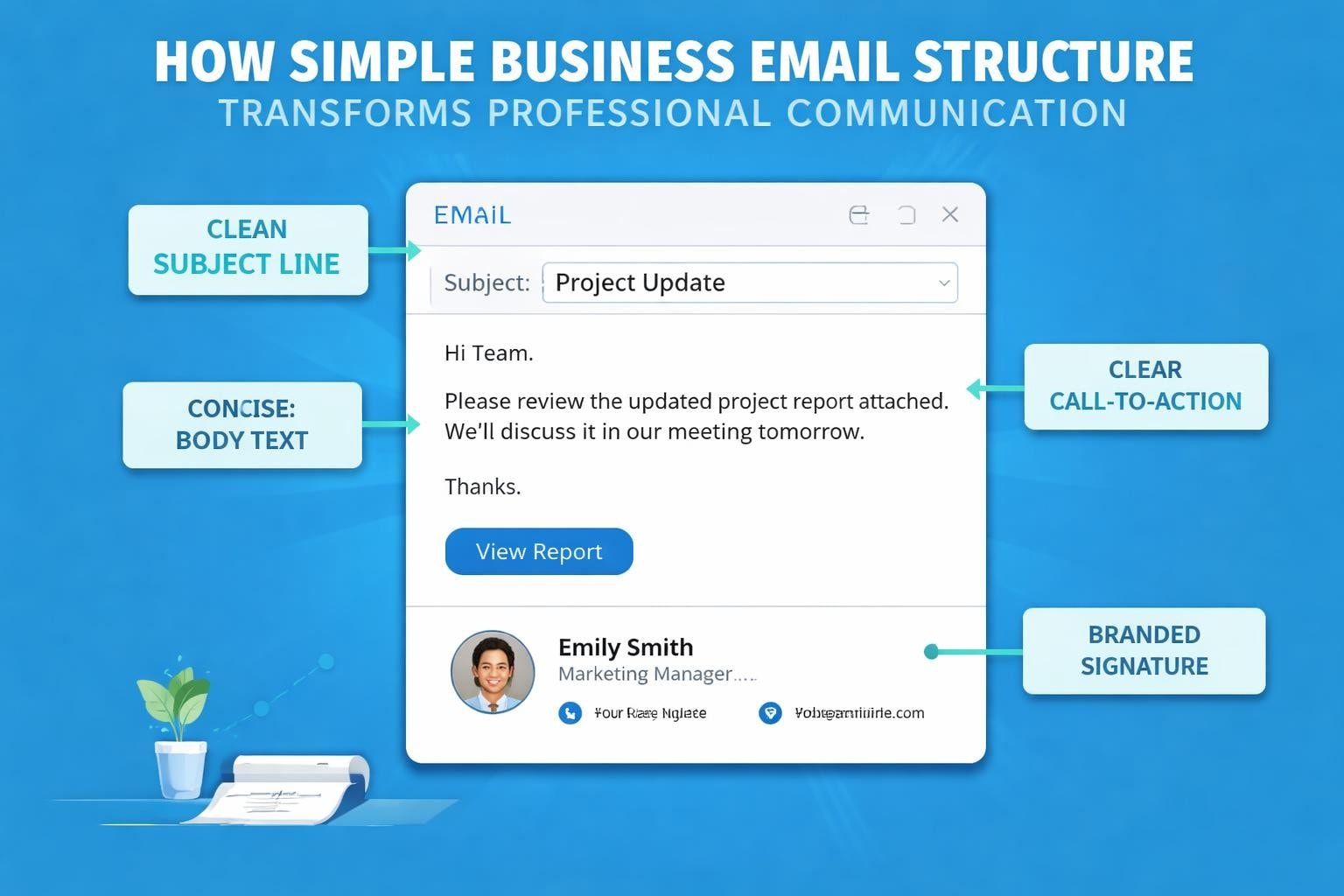
Email remains the backbone of professional communication in 2026, yet many small business owners struggle to craft messages that are both effective and efficient. A simple business email doesn't mean sacrificing professionalism or impact-it means stripping away unnecessary complexity to deliver clear, actionable messages that recipients appreciate and respond to. Whether you're reaching out to potential clients, following up with existing customers, or coordinating with team members, mastering the fundamentals of straightforward email communication can dramatically improve your business outcomes.
Why Simple Business Email Matters for Small Businesses
The average professional receives 121 emails daily, according to recent workplace productivity studies. In this crowded inbox environment, simple business email cuts through the noise by respecting your recipient's time whilst delivering your message with precision.
Small businesses face unique challenges when it comes to email communication. Without dedicated communications teams, owners and staff must handle everything from customer enquiries to partnership proposals. Simplicity becomes a strategic advantage rather than a limitation.
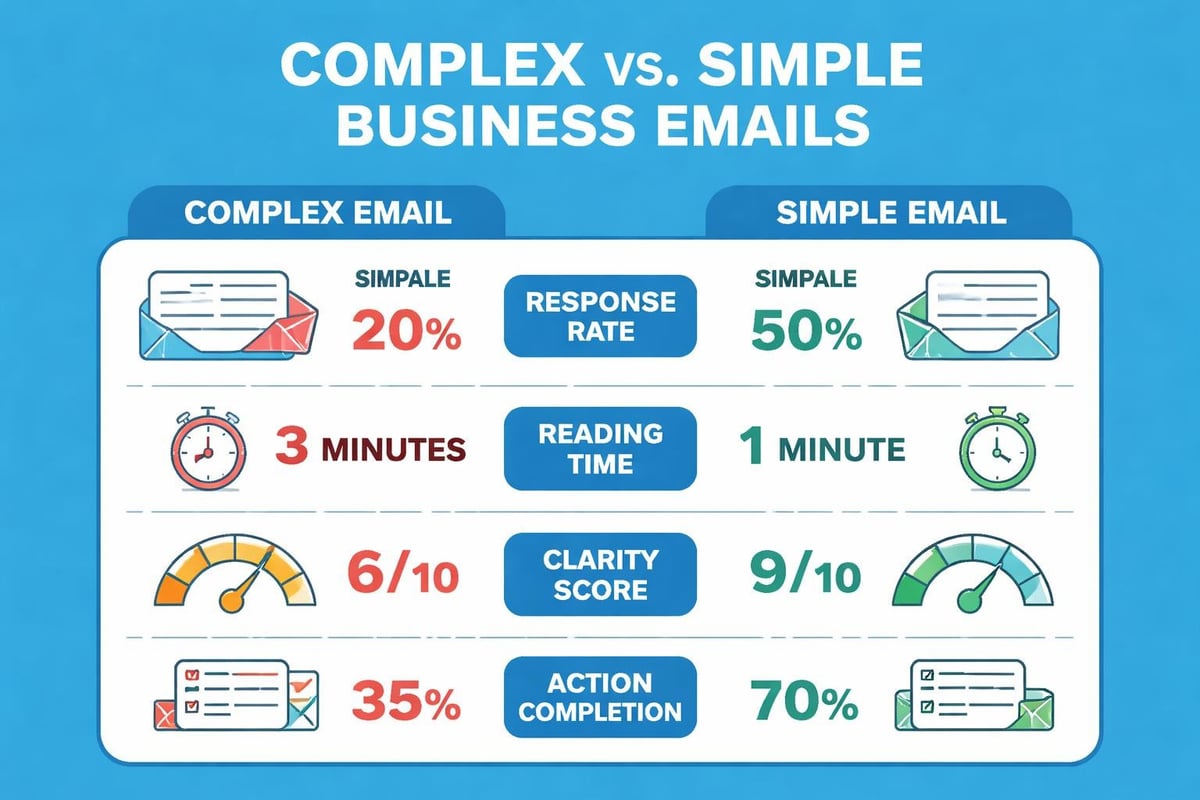
Research shows that emails with concise subject lines (fewer than 50 characters) achieve 12% higher open rates than longer alternatives. Similarly, messages under 200 words receive response rates up to 50% higher than lengthier correspondence. These metrics demonstrate that simple business email isn't just about convenience-it directly impacts your bottom line.
The Cost of Complicated Email
Complex, jargon-filled emails create multiple problems:
- Reduced comprehension: Recipients skim or misunderstand your message
- Delayed responses: Confusion leads to procrastination or ignored emails
- Damaged relationships: Overly formal or convoluted language creates distance
- Time waste: Crafting complicated emails takes longer for diminishing returns
By embracing straightforward communication, you demonstrate respect for your recipients' time whilst increasing the likelihood they'll take your desired action. For businesses getting started with email marketing, this foundation proves essential.
Core Elements of Effective Simple Business Email
Every simple business email should include specific components that work together to create clear, professional communication. Understanding these elements helps you construct messages that achieve your objectives without unnecessary embellishment.
Subject Lines That Command Attention
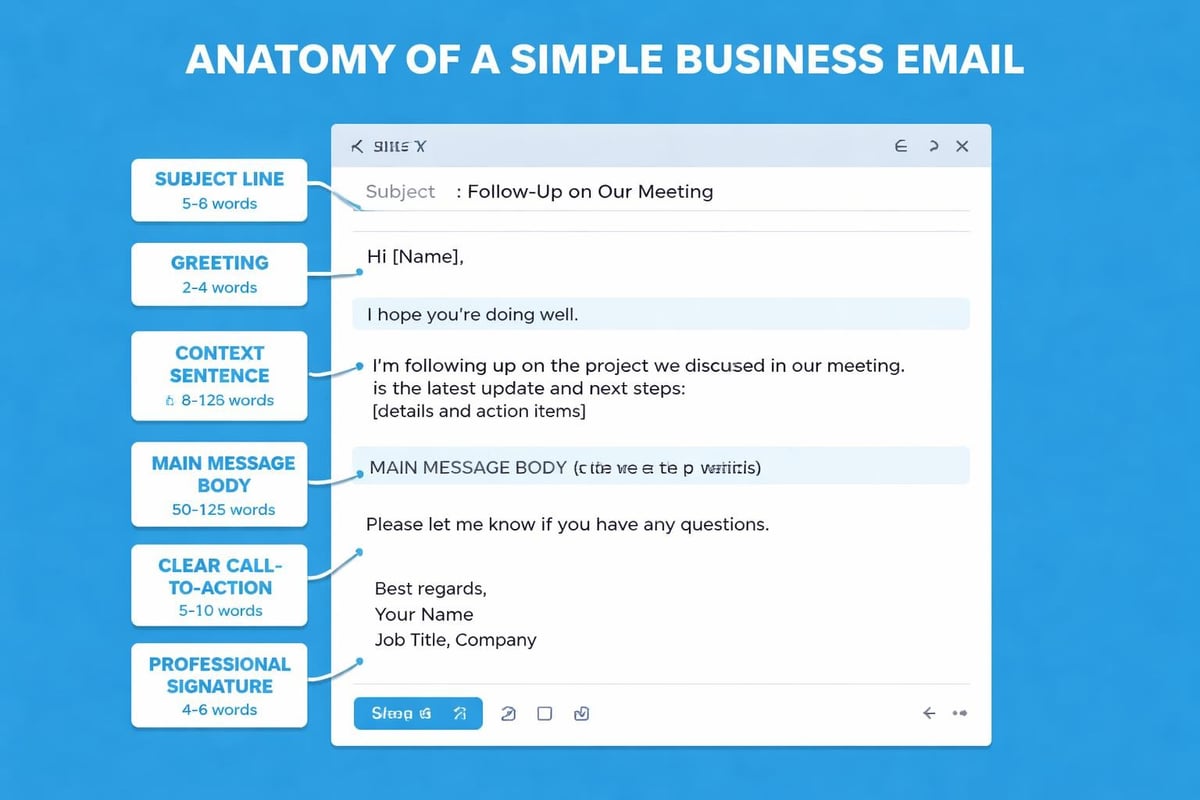
Your subject line determines whether recipients open your email. The most effective simple business email subject lines follow proven patterns:
| Subject Line Type | Example | Best Use Case |
|---|---|---|
| Direct request | "Meeting request: 15 minutes this Thursday" | Scheduling, approvals |
| Value proposition | "Reduce costs by 20% with new supplier" | Sales, partnerships |
| Status update | "Project Alpha: Phase 2 complete" | Internal updates |
| Question format | "Available for quick call about invoice?" | Follow-ups, clarification |
Clarity trumps cleverness in business communication. Whilst creative subject lines work for marketing campaigns, transactional and relationship emails benefit from transparent, descriptive headers that set accurate expectations.
Opening Greetings and Context Setting
The opening of your simple business email establishes tone and provides necessary context. Proper email etiquette emphasizes matching your greeting to your relationship with the recipient.
For established relationships, "Hi [Name]" or "Hello [Name]" works perfectly. First-time contacts benefit from slightly more formal approaches: "Dear [Name]" or "Good morning [Name]". Avoid outdated formality like "To Whom It May Concern" or "Dear Sir/Madam" unless absolutely necessary.
Immediately after your greeting, provide context in one sentence. Examples include:
- "Following up on our conversation from Tuesday..."
- "I'm reaching out regarding the proposal you requested..."
- "Quick question about next week's shipment..."
This contextual anchor helps recipients immediately understand why you're writing, particularly valuable when they manage hundreds of daily messages.
Structuring Your Message for Maximum Clarity
The body of your simple business email should follow a logical structure that guides readers from understanding to action. Breaking complex information into digestible segments improves comprehension and response rates.
The One-Purpose Rule
Each simple business email should accomplish one primary objective. Multiple topics create confusion about priority and expected responses. If you need to discuss three separate matters, send three focused emails rather than one lengthy message covering everything.
This approach delivers several benefits:
- Recipients can respond to individual topics when ready
- Follow-up becomes straightforward (referencing specific subject lines)
- Archive and search functions work more effectively
- Urgency levels remain clear for each separate matter
When creating professional email communications, this single-purpose discipline proves transformative for busy small business owners.
Paragraph and Sentence Length
Short paragraphs and sentences improve readability. Aim for paragraphs of 2-4 sentences maximum. Vary sentence length to maintain reader interest, but avoid complex subordinate clauses that require re-reading.
Consider this comparison:
Complex: "Following our discussion last week regarding the potential implementation of the new customer relationship management system, which would necessitate training for staff members across multiple departments whilst simultaneously requiring integration with existing platforms, I wanted to follow up on the timeline that was tentatively proposed during that conversation."
Simple business email version: "Thanks for discussing the new CRM system last week. I'm following up on the proposed implementation timeline. Could you confirm whether the March start date still works for your team?"
The second version communicates identical information in one-third the words, demonstrating that simple business email improves rather than diminishes professional communication.
Templates for Common Business Scenarios
Having templates for frequent situations helps maintain consistency whilst saving time. These business email examples demonstrate how simple business email applies across different contexts.
Introduction Email
Subject: Introduction from [Your Name] at [Your Company]
Hi [Name],
[Mutual connection] suggested I reach out regarding [specific topic]. We help [target audience] achieve [specific outcome] through [your solution].
Would you be open to a brief 15-minute call next week to explore whether this might benefit [their company]?
Best regards, [Your signature]
Follow-Up Email
Subject: Following up: [Original subject]
Hi [Name],
I sent an email last [timeframe] about [topic]. I understand you're busy-just wanted to check if you had thoughts on [specific question]?
Happy to provide any additional information you need.
Thanks, [Your signature]
Meeting Request
Subject: Meeting request: [Topic] - [Proposed duration]
Hi [Name],
I'd like to discuss [specific topic] and get your input on [decision/question]. Are you available for [duration] on [date options]?
Agenda:
- [Point 1]
- [Point 2]
- [Point 3]
Let me know what works for your schedule.
Regards, [Your signature]
These templates maintain the simple business email principle whilst adapting to different professional scenarios. For small businesses managing customer relationships, email marketing platforms often include template libraries that can be customized further.
Technical Considerations for Simple Business Email
Beyond content and structure, technical elements significantly impact how your simple business email performs. Small businesses must address these foundational aspects to ensure their messages reach recipients and create positive impressions.
Professional Email Address Selection
Your email address represents your brand before recipients even open your message. Choosing professional email name ideas requires balancing recognizability with simplicity.
Best practices include:
| Recommended Format | Example | Best For |
|---|---|---|
| firstname@company.com | sarah@astonishemail.com | Individual communication |
| role@company.com | support@astonishemail.com | Team inboxes |
| department@company.com | sales@astonishemail.com | Departmental contact |
Avoid numbers, underscores, or multiple periods in business email addresses. These elements appear unprofessional and create confusion when verbally sharing contact information. When setting up a business email, consistency across your organization strengthens brand recognition.
Signature Block Essentials
Every simple business email should include a professional signature containing relevant contact information. However, simplicity applies here as well-avoid cluttered signatures with excessive social media icons, multiple phone numbers, or lengthy disclaimers.
Essential elements:
- Full name
- Job title
- Company name
- Primary phone number
- Company website URL
Optional elements should be evaluated based on actual utility. Do recipients genuinely need your physical address in every email? Will they use five different social media links? Streamline to what genuinely facilitates communication.
Mobile Optimization for Simple Business Email
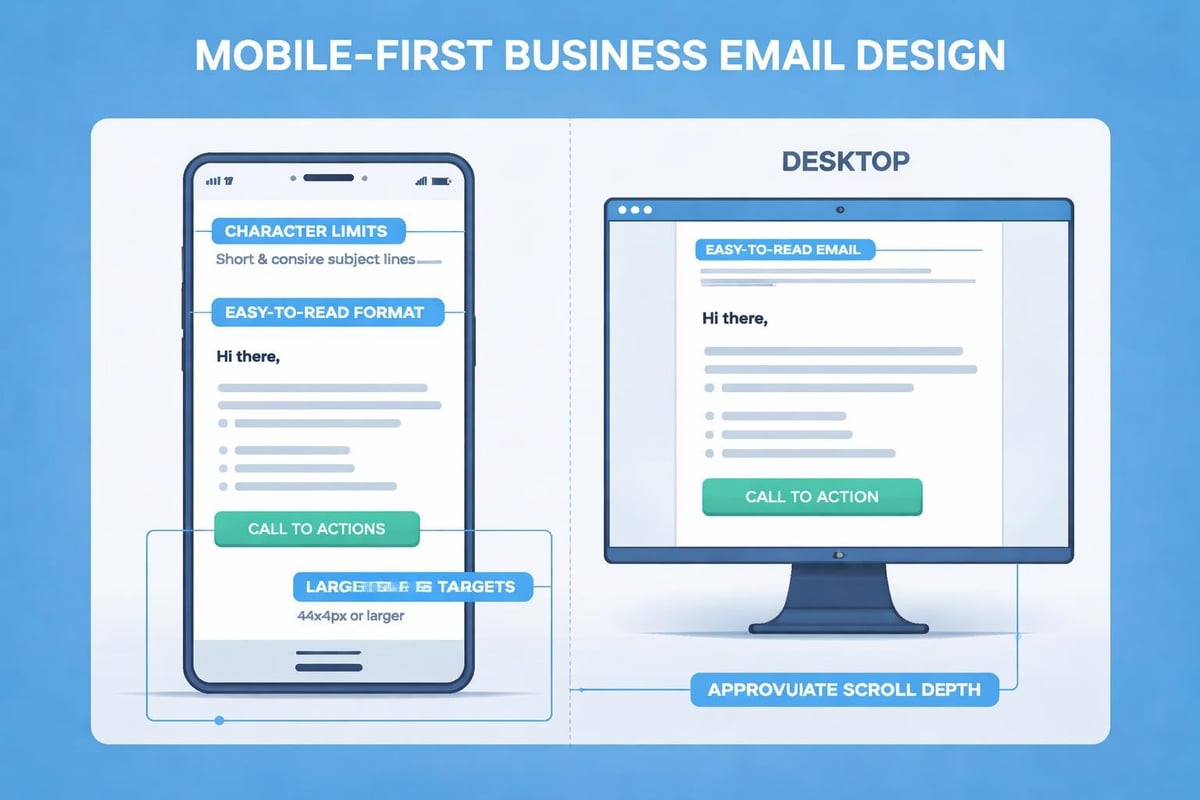
Over 60% of business emails are now opened on mobile devices. This shift makes simple business email not just preferable but essential. Complex formatting, long paragraphs, and large images create poor mobile experiences that reduce engagement.
Responsive Design Principles
When composing messages, assume recipients will read on smartphones:
- Front-load important information in the first two sentences
- Use short paragraphs (1-3 sentences)
- Limit line length to 40-50 characters when possible
- Place calls-to-action early in the message
- Test messages on your own mobile device before sending
For small businesses running email marketing campaigns, platforms like Astonish Email automatically optimize formatting for various devices, ensuring your simple business email displays correctly regardless of how recipients access their inbox.
Subject Line Mobile Considerations
Mobile devices typically display only 30-40 characters of subject lines. This limitation reinforces the value of concise, front-loaded subjects that communicate value immediately. Position key information at the beginning: "Invoice #1234 ready for review" works better than "Please review when convenient: Invoice #1234".
Common Mistakes That Complicate Business Email
Even well-intentioned professionals fall into traps that undermine their simple business email efforts. Recognizing these patterns helps you avoid communication pitfalls that reduce effectiveness.
Over-Explanation and Context Overload
Many writers feel compelled to provide extensive background before reaching their actual point. Whilst context matters, excessive preamble frustrates recipients who want immediate clarity about why you're writing.
Compare these approaches:
Over-explained: "As you may recall from our initial conversation in September 2025, when we first discussed the possibility of collaborating on the Johnson project, which subsequently evolved to include additional stakeholders who brought their own perspectives and requirements, I wanted to touch base regarding the next steps that we tentatively outlined during our follow-up meeting..."
Simple business email approach: "Quick update on the Johnson project: the additional stakeholders have joined, and we're ready for next steps. Can we schedule 30 minutes this week to finalize the timeline?"
Trust that recipients remember prior conversations or can ask for clarification if needed. When sending email messages to busy professionals, brevity demonstrates respect for their time.
Unnecessary Formality and Corporate Jargon
Business communication benefits from professionalism without rigid formality. Phrases like "per your request," "enclosed please find," or "at your earliest convenience" add length without value. Modern simple business email uses natural language that sounds like human conversation.
Replace formal phrases with conversational alternatives:
- "Attached is..." → "I've attached..."
- "Please be advised that..." → "Please note..." or simply state the fact
- "In reference to..." → "About..."
- "At this point in time..." → "Now..." or "Currently..."
This doesn't mean adopting casual slang or abandoning professionalism. It means writing as you would speak to a colleague you respect-clear, direct, and genuine.
Best Practices for Different Business Email Types
Simple business email principles apply universally, but different message types benefit from specific adaptations. Understanding these nuances helps you craft appropriate communications across various situations.
Customer Service Emails
When responding to customer enquiries or complaints, simple business email requires balancing efficiency with empathy. Professional email communication in customer service contexts demands particular attention to tone.
Key elements include:
- Acknowledgment: Confirm you understand their issue
- Action: Explain what you're doing to resolve it
- Timeline: Provide realistic expectations
- Follow-up: Indicate next steps or contact information
Example structure:
"Thank you for reaching out about [issue]. I understand this has caused [impact], and I apologize for the inconvenience.
I've [action taken] and expect [resolution] by [timeline]. I'll follow up on [date] to confirm everything is resolved.
Please contact me directly at [email/phone] if you have questions in the meantime."
Sales and Prospecting Emails
Sales emails walk a fine line between providing value and requesting action. The most effective simple business email for sales focuses on recipient benefits rather than product features.
Structure your sales emails around:
- Problem identification (showing you understand their challenge)
- Solution overview (how you address that specific challenge)
- Social proof (brief mention of similar clients or results)
- Clear next step (specific, low-commitment action)
Avoid lengthy product descriptions or feature lists in initial outreach. Your goal is securing a conversation, not closing the sale via email. For businesses managing larger contact lists, email marketing tools help track engagement and optimize messaging based on recipient behavior.
Internal Team Communication
Internal emails often become unnecessarily formal or, conversely, too casual. Simple business email for team communication should prioritize clarity and action items over extensive discussion.
Use these guidelines:
- Bold or highlight action items and deadlines
- Put requests at the beginning, not buried in paragraphs
- Use bullet points for multiple items requiring response
- Include relevant stakeholders in CC only when necessary
- Move lengthy discussions to scheduled meetings or collaborative documents
For ecommerce businesses particularly, tools like Talk Shop's Shopify Discord community offer alternatives to email for quick team questions and real-time collaboration, reserving email for formal documentation and asynchronous communication that requires permanent records.
Measuring Simple Business Email Effectiveness
How do you know whether your simple business email approach works? Small businesses should track specific metrics that indicate communication effectiveness and adjust strategies accordingly.
Key Performance Indicators
Different email types require different success metrics:
| Email Type | Primary Metric | Secondary Metric | Target Rate |
|---|---|---|---|
| Customer service | Response satisfaction | Resolution time | 90%+ satisfaction |
| Sales outreach | Reply rate | Meeting conversion | 15-25% replies |
| Newsletter | Open rate | Click-through rate | 20-30% opens |
| Transactional | Delivery rate | Action completion | 95%+ delivery |
When creating professional email addresses and campaigns, establishing baseline metrics helps you measure improvement as you refine your simple business email approach.
A/B Testing for Continuous Improvement
Even small businesses can implement basic testing to optimize email performance. Test one variable at a time:
- Subject line length (short vs. medium)
- Call-to-action placement (early vs. end)
- Paragraph length (2 sentences vs. 4 sentences)
- Greeting formality (Hi vs. Dear)
Document results and apply learnings to future communications. Expert guidance on crafting effective emails emphasizes that continuous refinement based on actual results outperforms assumptions about what "should" work.
Maintaining Consistency Across Your Organization
As small businesses grow, maintaining simple business email standards across team members becomes increasingly important. Inconsistent communication creates confusion about your brand and professionalism standards.
Creating an Email Style Guide
Document your organization's approach to common scenarios:
- Approved email signature formats
- Standard greetings for different relationship types
- Response time expectations for various email categories
- Template library for frequent communications
- Brand voice guidelines (tone, formality level, language preferences)
This doesn't require extensive documentation. A simple two-page reference covering these elements provides sufficient guidance for most small business teams. Share this during onboarding and reference it when reviewing team communications.
Technology That Supports Simplicity
The right tools make simple business email easier to implement consistently. Look for platforms offering:
- Template libraries that ensure brand consistency
- Mobile-optimized composition and preview
- Scheduling features for optimal send times
- Analytics dashboards tracking performance metrics
- Integration capabilities with your CRM and other business tools
For small businesses focused on email marketing, specialized platforms provide these features without the complexity of enterprise solutions. Understanding your email marketing needs helps identify the right balance of functionality and simplicity.
Adapting Simple Business Email for Different Industries
Whilst core principles remain consistent, simple business email manifests differently across industries. Understanding these nuances helps you apply best practices to your specific context.
B2B Service Businesses
Professional services firms (consultants, agencies, accountants) benefit from simple business email that emphasizes expertise whilst remaining approachable. These businesses should:
- Use case studies and specific examples rather than abstract descriptions
- Include clear pricing or engagement model information early
- Provide educational content that demonstrates knowledge
- Respect that decision-makers are extremely time-constrained
Retail and Ecommerce
Businesses selling products directly to consumers need simple business email that drives action without overwhelming recipients. Effective approaches include:
- Clear product benefits in scannable formats
- Prominent calls-to-action with minimal friction
- Mobile-first design (most retail emails open on phones)
- Personalization based on purchase history or browsing behavior
Ecommerce merchants can find valuable insights on optimizing customer communication through communities like Talk Shop, where experienced Shopify merchants share proven strategies for email engagement and conversion.
Professional Services
Lawyers, doctors, financial advisors, and similar professionals require simple business email that maintains appropriate formality whilst avoiding legal jargon or technical terminology that confuses clients. These practitioners should:
- Explain complex concepts in plain language
- Use analogies familiar to general audiences
- Break regulatory information into digestible segments
- Provide clear next steps for any required client action
Simple Business Email Etiquette for Global Communication
As small businesses increasingly work with international clients and partners, simple business email must account for cultural differences and language considerations. What reads as appropriately direct in one culture may seem rude in another.
Language and Translation Considerations
When emailing non-native English speakers, simplicity becomes even more valuable:
- Avoid idioms and cultural references ("touch base," "circle back," etc.)
- Use active voice and straightforward sentence structure
- Define acronyms and industry-specific terms
- Consider providing key information in bullet format for easier translation
- Be patient with language differences in replies
Time Zone Awareness
Business email best practices include respecting recipients' time zones. When scheduling meetings or setting expectations for responses, acknowledge that your Monday morning might be someone else's Monday evening.
Use specific dates rather than relative time references ("Thursday, April 24th" rather than "next Thursday") to avoid confusion across time zones. Tools that display multiple time zones help prevent scheduling mishaps.
Mastering simple business email transforms how small businesses communicate with customers, partners, and team members, creating clearer understanding whilst saving time for everyone involved. By focusing on concise messaging, logical structure, and recipient-focused content, you build stronger professional relationships and achieve better business outcomes. Astonish Email provides the tools small businesses need to implement these strategies at scale, with intuitive templates, mobile optimization, and analytics that help you continuously improve your email marketing effectiveness.